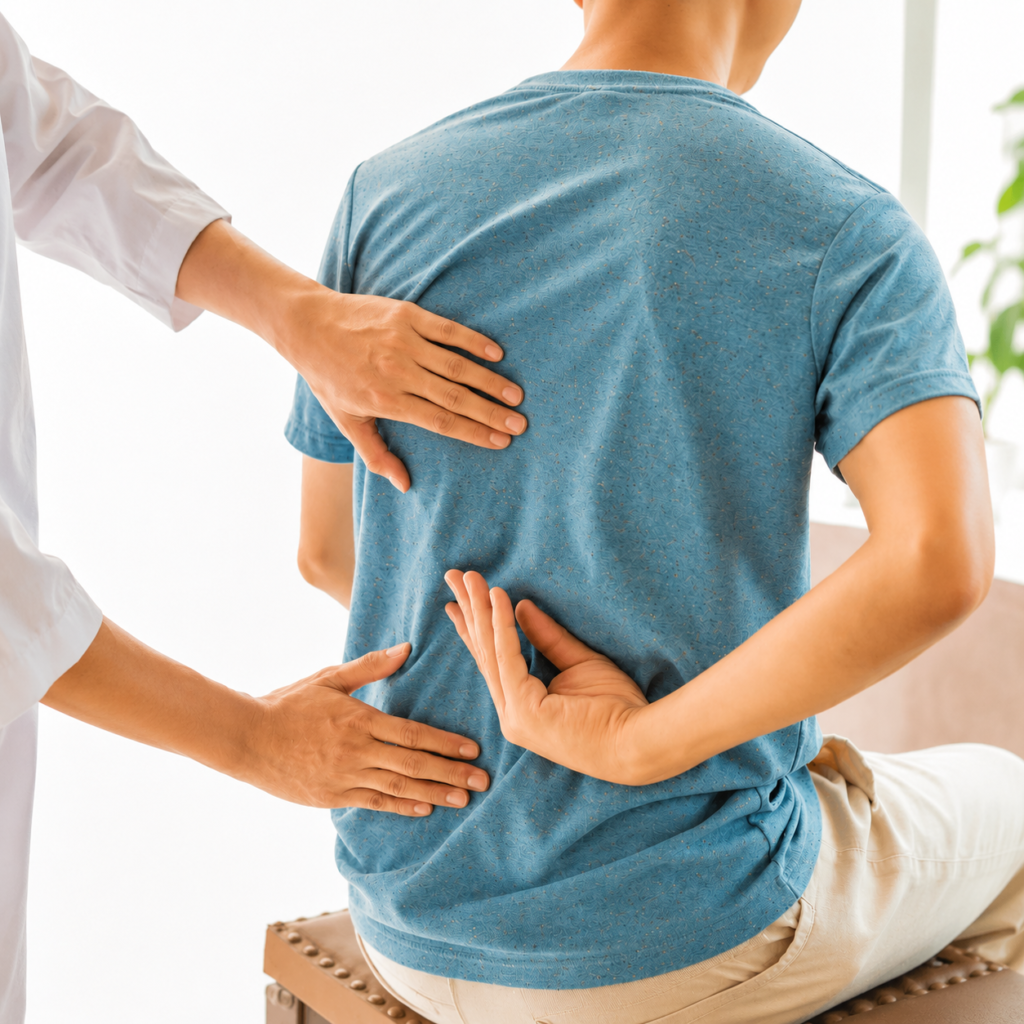
When a sudden back spasm strikes, the standard response is highly predictable: heating pads, over-the-counter NSAIDs, and immediate rest. While these interventions may temporarily lower nociceptive (pain) signaling, they treat back pain purely as an isolated symptom rather than a complex failure of structural biomechanics.
For those seeking sustainable recovery, clinical evidence reveals that true resolution requires addressing the underlying spinal mechanics. Utilizing targeted medical strategies, such as professional back pain treatment, shifts the focus from short-term symptom suppression to structural rehabilitation and long-term stabilization.
1. Deconstructing “Arthrogenic Muscle Inhibition”
When a spinal joint suffers an injury, micro-alignment issue, or disc pathology, the central nervous system alters its motor output to protect the area. This physiological response is known as Arthrogenic Muscle Inhibition (AMI).
Spinal Joint Dysfunction ──> Central Nervous System Distress ──> Inhibition of Stabilizers (e.g., Multifidus) ──> Compensatory Overactivation (Spasms)
During AMI, the brain diminishes neural drive to the deep, stabilizing muscles of the spine—specifically the lumbar multifidus and transversus abdominis.
- The Consequence: Because these stabilizers fail to fire correctly, larger global muscles (like the erector spinae) must overcompensate to keep the spine upright.
- The Symptom: This overcompensation leads to the painful, persistent muscle spasms that people often mistake for simple “muscle strain.”
Clinical diagnostics allow specialists to identify exactly which muscle pathways are inhibited, using targeted protocols to restore normal neuromuscular recruitment before permanent muscle atrophy or fatty infiltration occurs.
2. Restoring the Three Components of Spinal Stability
Biomechanical research dictates that spinal stability relies entirely on a well-coordinated triad known as Panjabi’s Stability Model. Long-term relief is impossible if a treatment plan only addresses one component while ignoring the other two.
Professional clinical treatment works across all three components simultaneously:
- The Passive Subsystem: Modern spinal decompression and manual adjustments optimize joint space and mechanics, reducing localized intradiscal pressure.
- The Active Subsystem: Rehabilitation protocols move beyond general fitness to isolate and strengthen the deep stabilizers that counteract shear forces on the lumbar spine.
- The Neural Control Subsystem: Precise clinical therapies re-train the central nervous system’s motor patterns, ensuring that muscles fire with the correct timing and force during daily movement.
3. Breaking the Inflammatory Feedback Loop
When spinal joint mechanics are altered, the continuous mechanical friction triggers a localized chemical cascade. The body releases inflammatory cytokines and prostaglandins into the surrounding soft tissue. This chemical irritation lowers the threshold of local pain receptors (nociceptors), causing even minor movements to feel intensely painful.
Rest and medication rarely fix this loop because they do not change the physical stress causing the irritation. Professional interventions physically alter joint mechanics to reduce this shear stress. Improved biomechanics decrease the chemical inflammatory load, allowing damaged soft tissues to heal properly.
4. Objective Mechanical Re-Training vs. Generic Advice
Ergonomic advice found online is often too generic to be helpful because every spine has unique structural variations, such as varying degrees of lumbar lordosis or pelvic tilt. Professional care uses clinical assessments to identify specific movement faults.
| Daily Factor | Biomechanical Stressor | Clinical Intervention |
| Prolonged Sitting | Increases static intradiscal pressure; causes hip flexor shortening that pulls the pelvis forward. | Ergonomic adjustments to distribute weight through the ischial tuberosities; targeted hip flexor lengthening. |
| Lifting Patterns | High shear forces on the L4/S1 vertebrae due to lumbar flexion under load. | Neuromuscular re-education to emphasize a hip-hinge pattern, keeping the spine in a neutral zone. |
Shifting Focus to Long-Term Structural Health
Relying on temporary fixes for chronic back pain is a losing battle against physics. When you choose an evidence-based clinical approach, you change the actual mechanics of your spine.
Prioritizing a comprehensive strategy—such as evaluating options for specialized back pain treatment in Folsom—allows you to stop managing symptoms and start restoring the structural integrity your body needs to remain pain-free.